Showing posts with label follow. Show all posts

Friday, July 29, 2016

MARINE DEFENSE BATTALIONS


With the rapid expansion of the Japanese Empire throughout the Pacific basin and its imminent threat on U.S. interests and naval installations, the Marine Corps formed Defense Battalions commencing in 1939.
The role of these battalions was to provide for the defense of advance naval bases to include anti-aircraft and coastal defense. The battalions were equipped with anti-aircraft batteries to defend against air raids, coastal defense guns to defend against naval bombardment and machine guns to repel landing forces. Prior to the United States' entrance into World War II, 9 defense battalions had been formed and were posted at Wake Island (1st Defense Battalion), American Samoa (2nd, 7th and 8th Defense Battalions), Midway Island (3rd, 4th and 6th Defense Battalions), Iceland (5th Defense Battalion), and Guantanamo Bay (9th Defense Battalion).
As the the United States went on the offensive in the Pacific during 1943, the defense battalions roles were modified to defending key installations and territory seized by assault forces during the Pacific's "island hopping campaign". Along with a change in the role, light tanks and field artillery were added to their equipment inventories. Twenty defense battalions were eventually formed and these battalions participated in nearly every land battle, both Army and Marine Corps, in the Pacific Theater. These units were among the first that were disbanded at the end of World War II.

Tuesday, July 26, 2016

THIS DAY IN MARINE CORPS HISTORY: 27 July

"The First Recruits" by Col Charles Waterhouse, USMCR (Ret)

Significant Marine events on this date included a meeting in Martinique, raising the flag over Puerto Rico, island-hopping battles in the Pacific, plus a look at the Corps' 1st Commandant.


Friday, July 22, 2016

PHIBLEX ON VIEQUES ISLAND

Major Kevin McClernon, USMC meeting with his unit leaders and staff and the base camp is established in the background.

Vieques Island, Puerto Rico, July 1996. Commanded the Landing Force during the annual UNITAS Exercise. Here I'm meeting with some of the headquarters staff and unit leaders as the base camp is being established in the background. Besides U.S. Marines, the landing force included Brazilian, Colombian, Dutch, Peruvian and Venezuelan Marines. Additionally the staff was augmented by Marines from Argentina, Ecuador, Uruguay and a South African paratrooper.

This was one of the last amphibious landings conducted on Vieques as the Department of the Navy ceased operations on the island in 2001. The island had been used by the Navy and Marine Corps since 1941 to practice and perfect amphibious warfare techniques.


Wednesday, July 20, 2016

THIS DAY IN MARINE CORPS HISTORY

1st MAW F-8 "Crusader" conducting a close air support mission in South Vietnam, 1966.

Significant events on the day in the Corps' history include:
  • Expansion of Marine Corps aviation
  • The activation of the 23rd Marines
  • Participation in the Solomon Islands Campaign
  • OPERATION TALLY HO


Tuesday, July 19, 2016

U.S. Marine Corps History: July 20th


"Flying is hours and hours of boredom sprinkled with a few seconds of sheer terror."

-Gregory "Pappy" Boyington, USMC World War II ace and Medal of Honor recipient
Since its founding in 1775 the Marine Corps has served this nation "from the sea". From manning "the fighting tops" of the frigate navy through the bloody "island hopping campaign" of World War II, Marines have served as the nation's amphibious force in readiness.
A theme of this day in the Corps' history is Marine aviation. Included are its pre-World War II expansion, an action of the Marine component of the Cactus Air Force in the Central Pacific and supporting an U.S. Air Force operation over North Vietnam.
The Air Combat Element is an integral component of Marine Air Ground Task Forces (MAGTF). Its roles include; assault support to ground combat and support elements of the MAGTF, anti-air warfare, offensive air support, electronic warfare, control of aircraft and missiles, and aerial reconnaissance. Additionally, Marines provide squadrons and detachments to serve on aircraft carriers as part of the Navy's Carrier Air Wings.

Tuesday, July 12, 2016

MARINES IN CHINA DURING 1900

Sgt Alexander Foley was one of four Marines to earn the Medal of Honor on 13 July 1900.
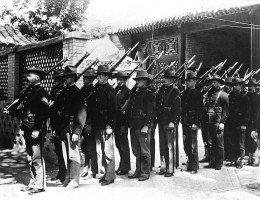
U.S. Marines in China, 1900

1900 - BOXER REBELLION

An allied force of 5,500 troops attacked and seized the old, walled, Boxer-controlled section of Tientsin, China. The allied force was comprised of American, British and Russian marines and soldiers.
The American brigade was commanded by Colonel Robert L. Meade, USMC. U.S. forces included the 1st Marine Regiment, a Marine artillery battery and two battalions of the U.S. Army's 9th Infantry Regiment.
Four Marines; Private James Cooney, Sergeant Alexander Foley, Private Clarence Mathias, and Sergeant Clarence Sutton, received Congressional Medals of Honor for their actions during battle. Their citations read as follows:
In the presence of the enemy during the battle near Tientsin, China, 13 July 1900, Cooney distinguished himself by meritorious conduct.
In the presence of the enemy in the battle near Tientsin, China, July 13, 1900, Foley distinguished himself by meritorious conduct.
In the presence of the enemy during the advance on Tientsin, China, 13 July 1900, Mathias distinguished himself by meritorious conduct.
In action during the battle near Tientsin, China, 13 July 1900. Although under heavy fire from the enemy, Sutton assisted in carrying a wounded officer from the field of battle.